
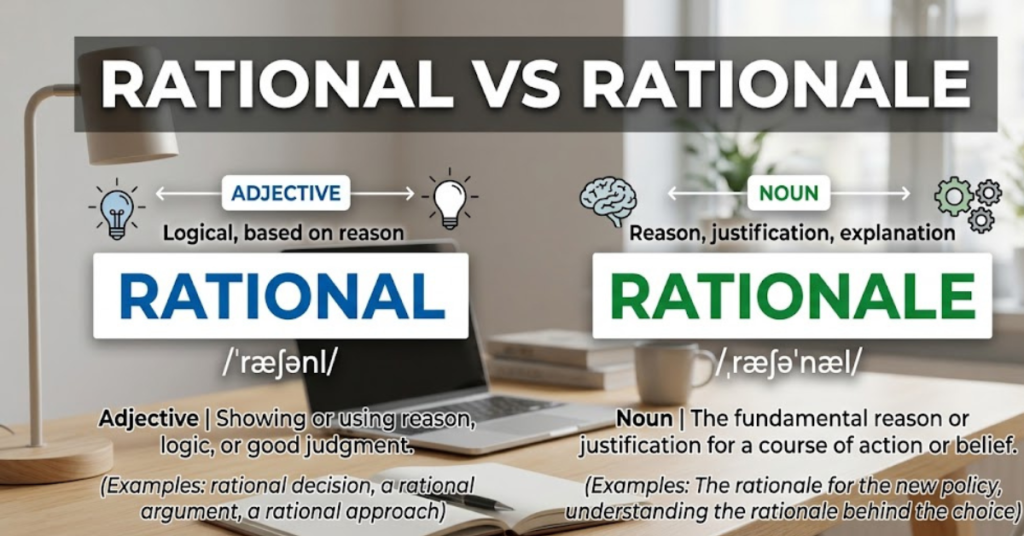

The confusion between rational vs rationale is incredibly common—even among fluent English speakers. The words look similar, sound related, and even come from the same root idea of “reason,” but they are used in completely different ways.
If you’ve ever paused mid-sentence wondering “should I use rational or rationale here?”, this guide will clear it up in a simple, practical way.
Quick Comparison: Rational vs Rationale
Let’s start with a clear side-by-side breakdown:
| Word | Part of Speech | Meaning | Example |
|---|---|---|---|
| Rational | Adjective | Logical, reasonable, based on facts | She made a rational decision under pressure. |
| Rationale | Noun | Explanation or reasoning behind something | The teacher explained the rationale behind the rule. |
What Does “Rational” Mean?
The word rational is an adjective used to describe a person, decision, or thought that is based on logic and clear thinking rather than emotion.
Key Idea of Rational:
Think logic, reason, and clear thinking
Common Uses of “Rational”
- Decision-making
- Problem-solving
- Behavior or thinking style
Examples:
- He remained rational during the crisis.
- It is a rational approach to solving the issue.
- Try to stay rational instead of emotional.
What Does “Rationale” Mean?
The word rationale is a noun. It refers to the reasoning or explanation behind an idea, decision, or action.
Key Idea of Rationale:
Think “why something is done”
Common Uses of “Rationale”
- Academic writing
- Business decisions
- Policy explanations
Examples:
- The manager explained the rationale for the new policy.
- What is the rationale behind this strategy?
- The report included a clear rationale for the changes.
Rational vs Rationale: Key Differences Explained
Let’s break it down more clearly:
1. Grammar Difference
- Rational → Adjective (describes something)
- Rationale → Noun (a thing or explanation)
2. Meaning Difference
- Rational → logical or sensible thinking
- Rationale → explanation or reasoning behind something
3. Usage Context
- Rational → describes people, thoughts, decisions
- Rationale → used for explanations, justifications, reasons
Simple Memory Trick
Here’s an easy way to remember:
- Rational = “a person acts rationally” (adjective behavior)
- Rationale = “answer to why” (noun explanation)
If you’re describing how someone thinks, use rational
If you’re explaining why something happened, use rationale
Real-Life Examples Side by Side
| Situation | Rational | Rationale |
| Decision | That was a rational choice. | The rationale was cost savings. |
| Behavior | She stayed rational under pressure. | Not used |
| Explanation | Not used | The rationale was clearly explained. |
| Thinking | He is a rational thinker. | Not used |
Common Mistakes People Make
Because both words share the same root, learners often confuse them:
Incorrect Examples:
- What is the rational behind this decision?
- What is the rationale behind this decision?
- She gave a rationale answer during the debate.
- She gave a rational answer during the debate.
Why These Words Are Confusing
The confusion happens because:
- They come from the same Latin root (ratio)
- They look very similar in spelling
- Both relate to “reason”
- People often hear them in formal discussions
FAQs: Rational vs Rationale
1. What is the difference between rational and rationale?
“Rational” is an adjective meaning logical, while “rationale” is a noun meaning explanation or reason.
2. Is rationale a verb or noun?
“Rationale” is a noun.
3. Can rational and rationale be used interchangeably?
No, they have different grammatical roles and meanings.
4. What is an example of rational thinking?
Making a decision based on facts instead of emotions is rational thinking.
5. What does “rationale behind” mean?
It means the reason or explanation behind a decision or action.
Conclusion
Understanding rational vs rationale becomes easy once you focus on grammar and meaning:
- Rational = logical, sensible, clear thinking (adjective)
- Rationale = explanation or reason behind something (noun)
A simple trick is: rational describes thinking, rationale explains why.
Once you remember that distinction, you’ll never mix them up again in writing or conversation.