
If a strange light suddenly appears on your dashboard while driving, it can feel a bit stressful—especially if you don’t know what it means. That’s exactly why understanding Hyundai dashboard symbols and meanings is so important.
In this guide, we’ll break down Hyundai dashboard symbols and meanings, explain the exclamation point Hyundai dashboard symbols and meanings, and even cover older models like the 2017 Hyundai dashboard symbols and meanings. Whether you’re a new driver or just need a quick refresher, this guide will make everything simple.
Let’s decode your dashboard step by step.
What Are Hyundai Dashboard Symbols and Meanings?
Modern vehicles like those from Hyundai use dashboard symbols to communicate the car’s health and safety status in real time.
Why These Symbols Are Important
- Warn you about mechanical issues
- Help prevent expensive repairs
- Improve driving safety
- Show system status updates
Think of them as your car’s “language” telling you what’s going on.
Hyundai Dashboard Symbols and Meanings Categories
Understanding Hyundai dashboard symbols and meanings becomes easier when you group them into three main categories.
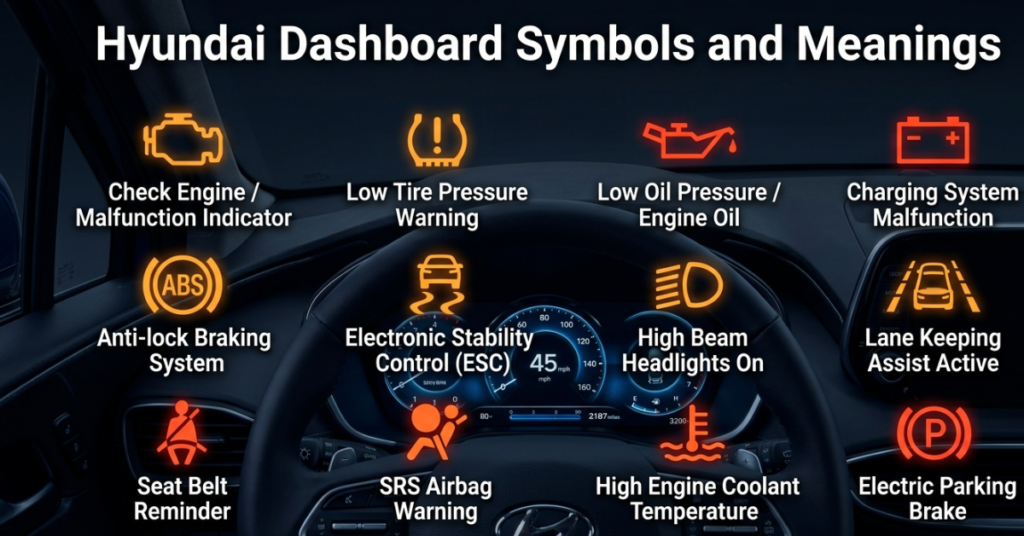
1. Red Warning Lights (Serious Alerts)
These signals mean stop or check immediately.
Common red warnings:
- Engine overheating
- Oil pressure low
- Brake system failure
- Battery charging issue
If you see a red light, don’t ignore it.
2. Yellow/Orange Warning Lights (Caution Signals)
These indicate potential issues that need attention soon.
Examples:
- Check engine light
- Tire pressure warning
- ABS system alert
- Stability control warning
You can usually keep driving, but get it checked quickly.
3. Green/Blue Indicator Lights (Normal Operation)
These are not warnings—they just show systems are active.
Examples:
- Headlights ON
- Cruise control active
- Turn signals
- High beam indicator
Exclamation Point Hyundai Dashboard Symbols and Meanings
One of the most confusing alerts is the exclamation point Hyundai dashboard symbols and meanings.
What It Usually Means
An exclamation mark can appear in different shapes:
1. Tire Pressure Warning (! inside tire shape)
- Meaning: Low tire pressure
- Action: Inflate tires to recommended PSI
2. Brake Warning (! in circle)
- Meaning: Brake issue or parking brake engaged
- Action: Check brake fluid or release handbrake
3. Master Warning Light (! triangle)
- Meaning: General system alert
- Action: Check dashboard message display
Always check your manual or display screen for details.
Hyundai Dashboard Symbols and Meanings PDF
Many drivers search for a Hyundai dashboard symbols and meanings PDF for quick reference.
What You’ll Find in a PDF Guide:
- Full symbol chart
- Color-coded warnings
- Model-specific alerts
- Emergency actions
You can usually find this in the official Hyundai owner’s manual or website.
2017 Hyundai Dashboard Symbols and Meanings
Older models like the 2017 Hyundai dashboard symbols and meanings system are slightly simpler but still important.
Common 2017 Hyundai Symbols
- Check engine light
- Oil pressure warning
- Airbag warning light
- ABS warning system
- Battery indicator
Key Difference from Newer Models
- Fewer driver-assist alerts
- Less advanced digital display
- More basic warning icons
Still, the meaning of core symbols remains the same.
Most Important Hyundai Warning Lights Explained
Let’s break down the most critical alerts you should never ignore.
Engine Warning Light
- Shape: Engine icon
- Meaning: Engine or emissions issue
- Action: Visit mechanic ASAP
Oil Pressure Warning
- Shape: Oil can icon
- Meaning: Low engine oil pressure
- Action: Stop driving immediately
Battery Warning Light
- Shape: Battery icon
- Meaning: Charging system problem
- Action: Check alternator or battery
Brake Warning Light
- Shape: Circle with exclamation
- Meaning: Brake system issue
- Action: Inspect brakes immediately
Tire Pressure Warning
- Shape: Exclamation inside tire
- Meaning: Low tire pressure
- Action: Inflate or repair tire
How to React When a Dashboard Light Comes On
Here’s a simple step-by-step approach:
Step 1: Identify the color
- Red = Emergency
- Yellow = Caution
- Green = Normal
Step 2: Check your dashboard message
Many Hyundai models show text explanations.
Step 3: Take action
- Stop if red light appears
- Schedule service for yellow lights
- Continue driving if green
Common Mistakes Drivers Make
Many people misunderstand Hyundai dashboard symbols and meanings.
Avoid these mistakes:
- Ignoring warning lights too long
- Assuming all lights mean emergencies
- Resetting lights without fixing issues
- Not checking tire pressure regularly
Read also <<< Nissan Dashboard Symbols and Meanings
FAQs
What do Hyundai dashboard symbol and meanings indicate?
They show vehicle status, warnings, and system alerts.
What does the exclamation point Hyundai dashboard symbol mean?
It usually indicates tire pressure, brake issues, or a general warning.
Where can I find a Hyundai dashboard symbol and meanings PDF?
In the official Hyundai owner’s manual or Hyundai website.
Are 2017 Hyundai dashboard symbols different?
They are simpler but mostly follow the same meanings as newer models.
What is the most serious Hyundai warning light?
Red lights like oil pressure, brake failure, or engine overheating.
Can I drive with a yellow warning light?
Yes, but you should get it checked soon.
Conclusion
Understanding Hyundai dashboard symbols and meanings is essential for safe and stress-free driving. These alerts are designed to protect your car and help you avoid serious issues.
Whether you’re dealing with the exclamation point Hyundai dashboard symbol and meaning, older systems like the 2017 Hyundai dashboard symbols and meaning, or looking for a Hyundai dashboard symbols and meaning PDF, the key is simple—never ignore what your car is trying to tell you.