
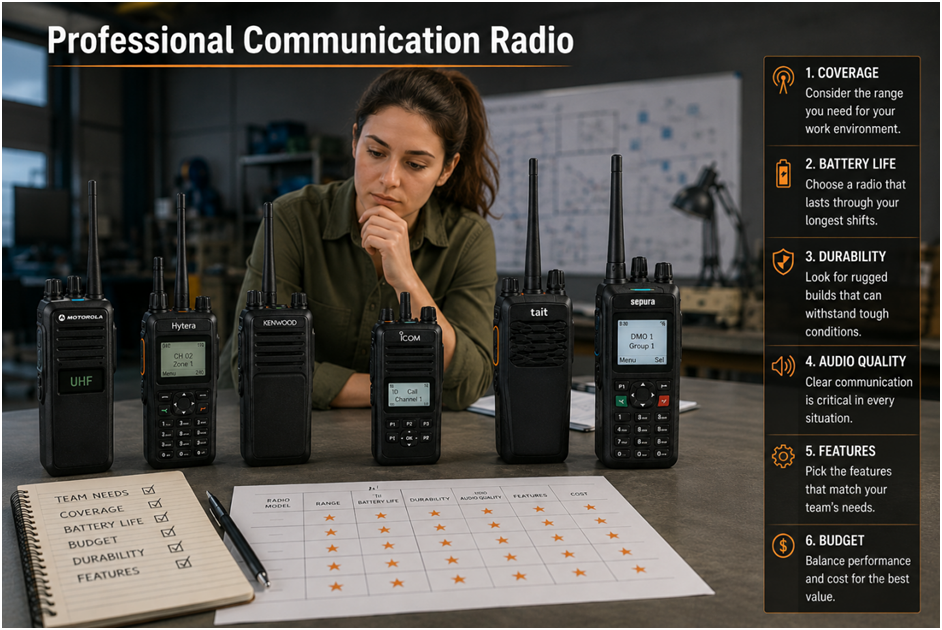

In today’s dynamic business and security landscape, effective communication is more than an advantage; it’s a fundamental necessity. From coordinating teams across vast industrial zones to managing emergencies in urban environments, having a reliable radiocommunication system can make the difference between success and failure. This article will guide you through the key considerations for selecting the perfect radiocommunication equipment, tailored to meet diverse operational demands.
Analog vs. Digital Radios: Which is the Best Option?
The evolution of technology has transformed communication RadioRed, offering options that go beyond simple voice transmission. Understanding the differences between analog and digital systems is the first step toward making an informed decision.
Advantages of Analog Radios
Analog radios have been the backbone of two-way communication for decades. Their simplicity of use and robustness make them ideal for basic operations. Models like the Hytera TC508 are known for their reliability and ease of handling, making them a popular choice for teams requiring direct, no-frills communication. They are perfect for environments where initial investment is a concern and communication needs are primarily voice-based.
The Leap to Digital Communication (DMR)
Digital Mobile Radio (DMR) technology represents a significant advancement. DMR radios, such as the Hytera BP516, offer superior audio quality, even in the noisiest environments, thanks to digital noise cancellation. Furthermore, DMR technology allows for more efficient use of the frequency spectrum, doubling communication capacity within the same bandwidth. This translates to more users communicating simultaneously without interference.
Key benefits of digital technology:
- Improved Audio Clarity: Crystal-clear voice in any condition, crucial for safety and efficiency.
- Longer Battery Life: Digital radios manage power more efficiently, extending battery life during long shifts.
- Advanced Features: Ability to send text messages, GPS data, telemetry, and emergency alarms, adding an extra layer of functionality and safety.
- Privacy and Security: Digital encryption offers greater protection against communication interception.
For organizations looking to modernize their infrastructure gradually, there are mixed-mode radios that can operate in both analog and digital systems, facilitating a smooth transition and protecting existing investments.
Detailed Analysis of Leading Models in the Market
To make an informed decision, it is essential to know the specifications of leading equipment. Below, we break down some of the most sought-after models for their excellent cost-benefit ratio.
| Feature | Hytera TC508 (Analog) | Hytera BP516 (Digital/DMR) | Hytera HP506 (Professional Digital) |
| Signal Type | Pure Analog | Digital & Analog | Digital & Analog |
| Channels | 16 channels | 64 channels / 4 zones | 256 channels / 8 zones |
| Durability | IP54 (Dust & splash-proof) | IP54 (Commercial heavy-duty) | IP67 (Submersible) |
| Power | 4W (UHF) / 5W (VHF) | 4W (UHF) / 5W (VHF) | 4W (UHF) / 5W (VHF) |
| Ideal For | Basic security, warehouses | Hospitality, logistics, retail | Heavy construction, industry |
Hytera TC508: The Workhorse
This model is renowned for its robust design and long-lasting battery, ensuring personnel remain connected throughout their shifts. It’s the preferred choice for those who don’t need complex features but require a radio that can withstand drops and constant use.
Hytera BP516: The New Commercial Standard
The BP516 redefines the commercial standard. Its high-power speaker ensures clear messages even near heavy machinery. Additionally, its USB-C charging capability allows users to charge it anywhere, reducing reliance on traditional charging bases.
Hytera HP506: Extreme Performance
When working conditions are extreme, the HP506 is the answer. With its IP67 certification, this radio can be submerged in water or washed without damage. Its design is slimmer and lighter than its predecessors, yet much more powerful in terms of audio processing and range.
Types of Radios and Their Specific Applications by Industry
Not all radios are created equal. Each work environment demands particular physical and technical characteristics. Here’s how different types of radios adapt to these needs.
Portable Radios: Indispensable Companions
Portable radios are the most versatile and common option. They are lightweight, compact, and designed to be carried by the user. They are widely used in security, events, hospitality, construction, and logistics. The Hytera HP506 is an outstanding example, with its robust design and IP67 certification, making it water and dust resistant, ideal for outdoor workers or adverse conditions.
Mobile Radios and Base Stations: Range and Power
For transport vehicles, security fleets, or emergency services, mobile radios installed in cars or trucks are essential. They offer higher transmission power and, therefore, greater range. Base stations, on the other hand, act as fixed command centers, providing extended coverage and centralized communication management in specific areas.
Marine and Aviation Radios: Specialized Communication
In coastal areas and airspace, communication is subject to strict international regulations. Marine radios are designed to withstand saline environments and are often submersible, while aviation radios operate on specific frequencies to ensure safety and coordination in air traffic.
The Importance of Intrinsically Safe (IS) Radios
In high-risk industries such as oil, gas, chemical, or mining, safety is paramount. Intrinsically Safe (IS) radios are devices designed to operate in potentially explosive atmospheres without generating sparks or heat that could ignite combustible gases, vapors, or dusts. These devices carry rigorous certifications like UL913 or ATEX, guaranteeing their safety in these critical environments. Investing in IS radios is not an option, but an obligation to protect workers’ lives and prevent catastrophes.
Repeaters: Expanding Communication Horizons
Even the most powerful radios have range limitations due to geography, topography, or urban structures. This is where repeaters become indispensable. A repeater receives a radio signal, amplifies it, and retransmits it, significantly extending the coverage area. Strategically placed at elevated points, repeaters can transform local communication into a network spanning large areas, such as an entire city or a vast industrial property.
Key elements of a repeater system:
- The Repeater: The central device that amplifies and retransmits the signal.
- Duplexer: Allows a single antenna to be used for simultaneous transmission and reception.
- High-Gain Antennas: Optimized to maximize signal range and quality.
- Reliable Power Sources: Including backup systems to ensure operational continuity.
Essential Accessories to Maximize Your Investment
A radio is only as good as its accessories. The right choice of complements can dramatically improve the functionality, comfort, and durability of your equipment.
- Long-Lasting Batteries: Essential for extended shifts, modern lithium-ion batteries offer superior performance with no memory effect.
- Headsets and Lapel Microphones: Allow for hands-free communication, ideal for security personnel, machinery operators, or any worker who needs their hands free.
- Protective Cases and Reinforced Clips: Protect the radio from bumps, drops, and daily wear and tear, extending its lifespan.
- Multi-Chargers: For charging multiple radios simultaneously, optimizing equipment management.
It is crucial to invest in original accessories to ensure compatibility and avoid compromising the manufacturer’s warranty. At radiored.com.mx, you can find a wide range of original accessories that perfectly complement your Hytera equipment.
The PoC Revolution: Communication Without Distance Limits
One of the most exciting innovations in radiocommunication is Push-to-Talk over Cellular (PoC) technology. This solution uses cellular networks (3G, 4G, 5G) and Wi-Fi to provide instant communication, eliminating the range restrictions of traditional radios. With PoC, a work team can communicate nationally or even internationally with the same ease as if they were in the same room.
Why consider PoC?
- Extensive Coverage: Leverages existing cellular infrastructure, offering national communication without the need for proprietary repeaters.
- Cost-Effectiveness: Reduces the need for large investments in radio infrastructure.
- Multimedia Functionalities: Many PoC devices integrate video, image, and real-time GPS location capabilities.
This technology is ideal for logistics companies, transportation, private security with operations in multiple cities, and any organization requiring instant, wide-ranging communication without the limitations of traditional radio systems.
Regulatory Framework and Frequencies: What You Need to Know
The use of the radio spectrum is strictly regulated by national telecommunications authorities. It is imperative to operate within legal boundaries to avoid penalties. The most common frequency bands for commercial use are VHF (Very High Frequency) and UHF (Ultra High Frequency).
- VHF: Ideal for rural areas and open spaces, where the signal can travel long distances with few obstacles.
- UHF: Preferred for urban environments and buildings, as its shorter waves better penetrate structures.
A trusted provider like RadioRed will not only sell you the equipment but also advise you on the necessary permits and proper programming of your radios to comply with current regulations.
Practical Tips for Maintaining Your Radios
To ensure a long lifespan and optimal performance of your equipment, preventive maintenance is key:
- Regular Cleaning: Keep radios clean from dust and dirt. Use a soft, slightly damp cloth.
- Battery Care: Avoid overcharging and complete discharge. Store batteries in a cool, dry place.
- Antenna Inspection: Periodically check that antennas are not bent or damaged, as this affects range and can damage the radio.
- Protection Against Extreme Temperatures: Do not expose radios to excessive heat or cold, which can affect electronics and battery life.
Conclusion: Connectivity is Power
Choosing the right radiocommunication system is a strategic decision that directly impacts the efficiency, safety, and productivity of any operation. From the robustness of analog radios to the sophistication of digital and PoC systems, the options are varied and adapt to every need.
Do not underestimate the value of clear and constant communication. In critical moments, your team’s ability to communicate without failure is invaluable. To explore the latest innovations and acquire equipment from leading brands like Hytera with the warranty and technical support your company deserves, we invite you to visit RadioRed. Discover how radiocommunication technology can empower your business and ensure every message reaches its destination quickly, securely, and professionally.
Investing in the right communication is investing in the future of your company. Trust the experts to guide you on this crucial path.